19 artifact presets
Grouped by what you hear — fizzy hash, glassy cymbals, laser whistles, plastic vocals, harsh veil. Hit Analyze and Shimmer picks the right one and tells you why, or choose yourself. Every preset has a 0–200% strength dial.
Free · Open source · 100% offline · by The Treq
Clean up AI music artifacts.
Then master for release.
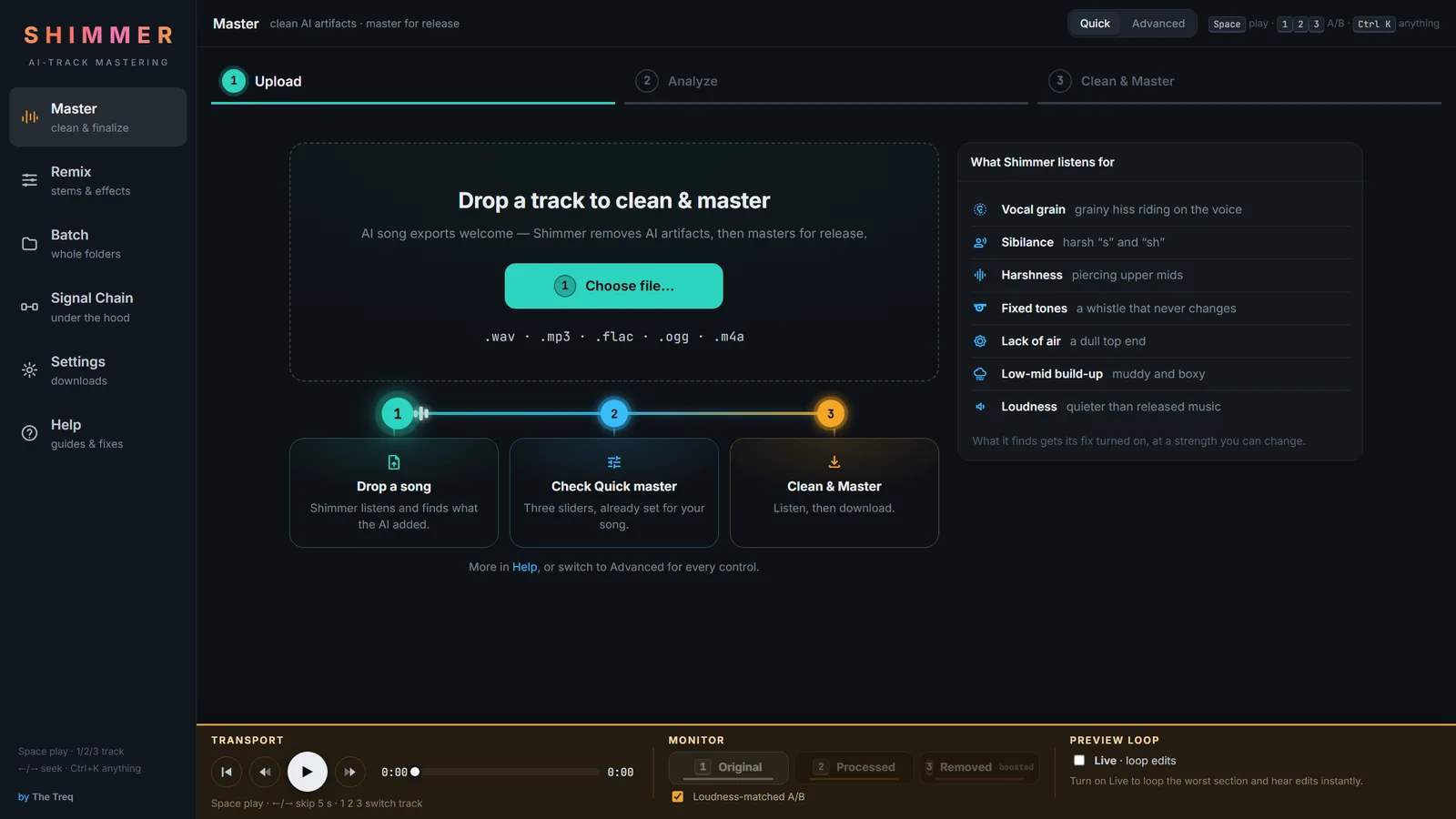
The fizz on your cymbals and the plastic sheen on your vocals aren't in your mix — the model put them there. Shimmer finds that noise, strips it out, and masters the cleaned track so it's ready to upload.
The problem
You generate a track and it sounds great — until you really listen. A thin, fizzy hash rides the cymbals. The vocals wear a glassy sheen. Turn it up on good speakers and it gets worse.
That's a generation artifact — hiss, flicker, and metallic ringing that AI music models leave behind, usually between 5 kHz and 12 kHz. Normal mastering tools treat it as part of your music, so they compress it, brighten it, and make it louder.
What Shimmer does
That order matters. Master first and you just make the fizz louder.
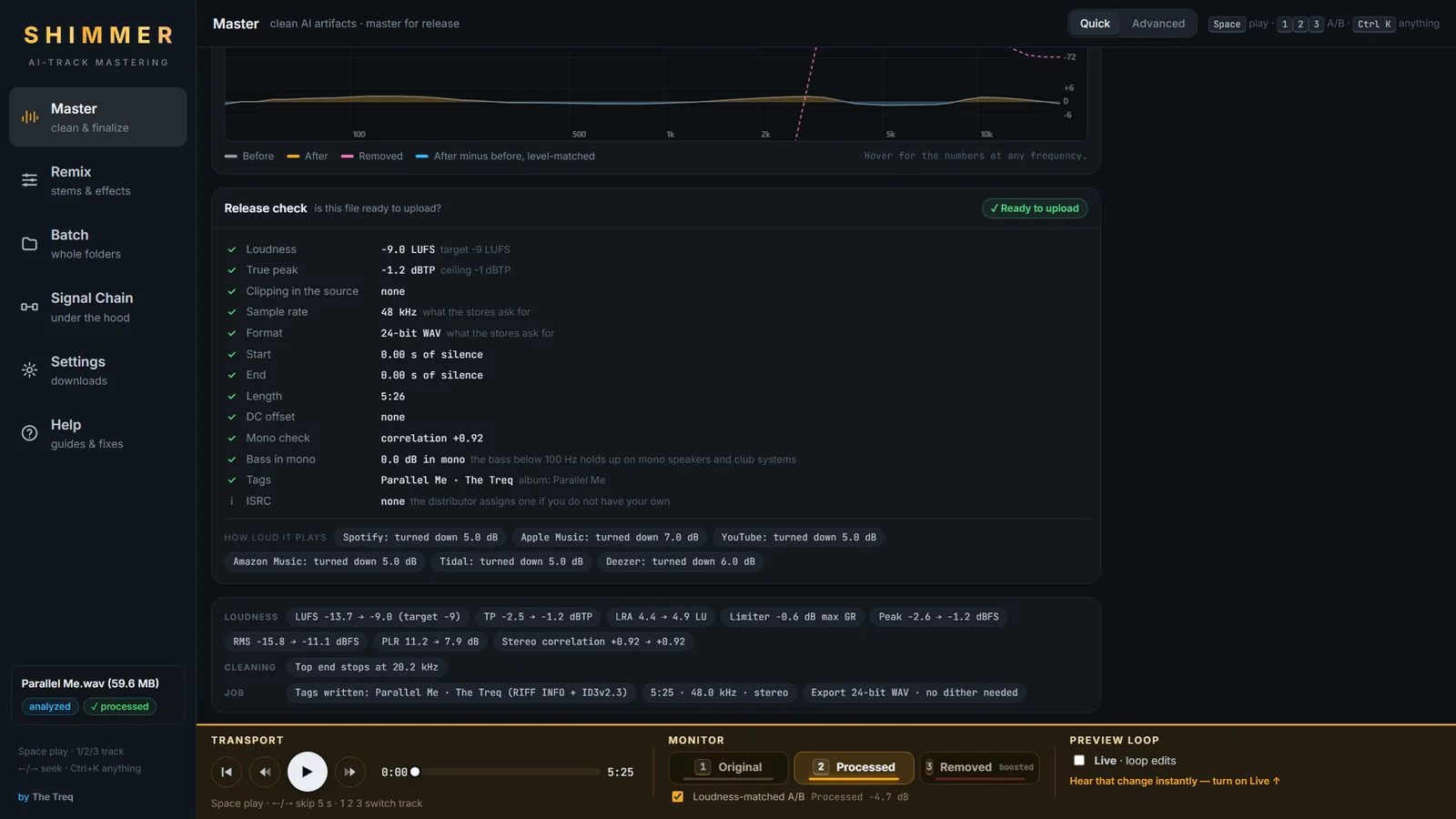
The safety check no one else gives you
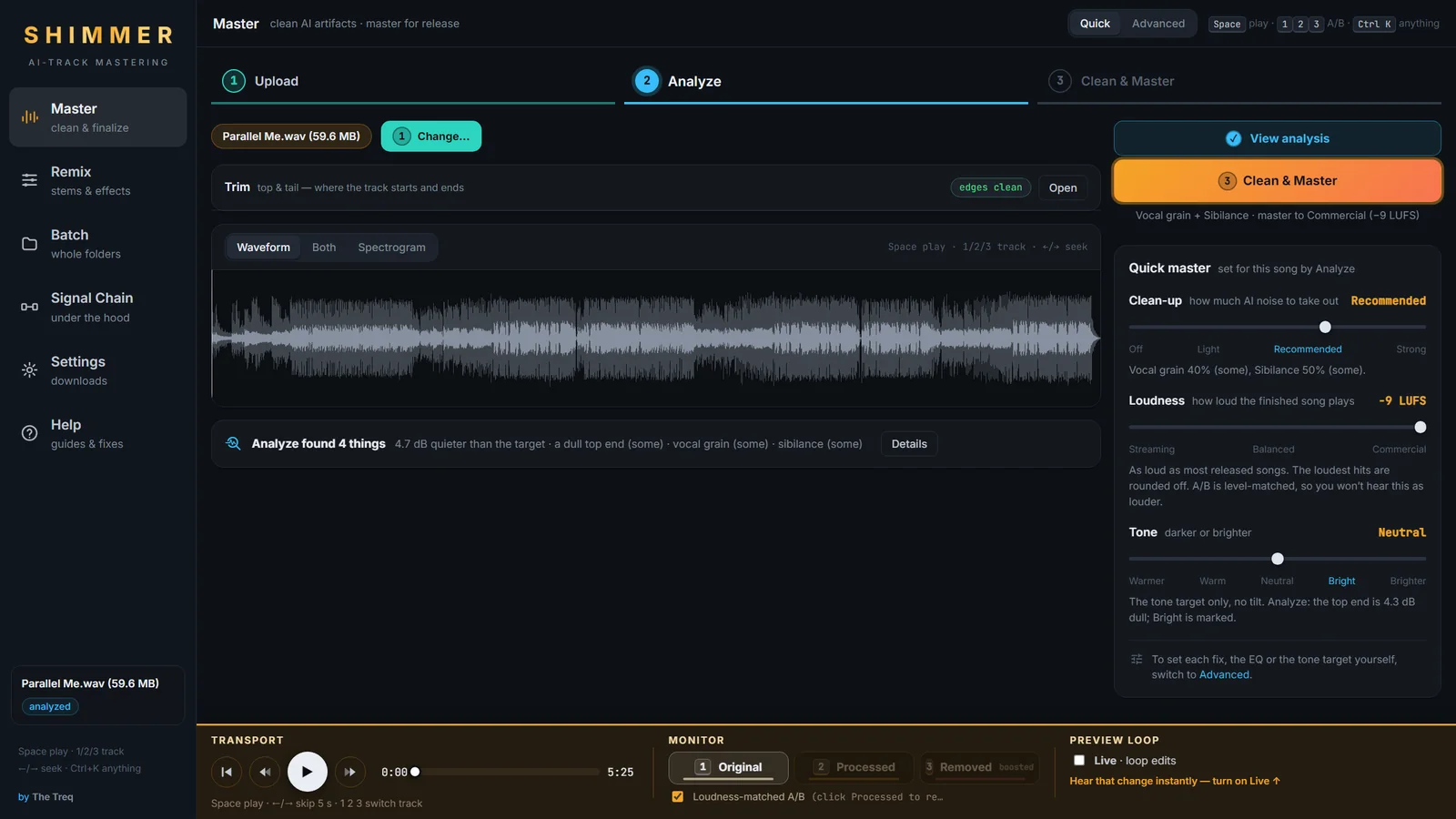
While your song plays, switch between three versions with the 1 2 3 keys — loudness-matched, so your ears judge the sound, not the volume.
Your untouched upload.
Cleaned and mastered.
Only what Shimmer took out — turned up so you can hear it. If there's music in here, you're cutting too hard.
What's inside
Grouped by what you hear — fizzy hash, glassy cymbals, laser whistles, plastic vocals, harsh veil. Hit Analyze and Shimmer picks the right one and tells you why, or choose yourself. Every preset has a 0–200% strength dial.
Streaming (−14 LUFS), Loud (−11), or CD/Club (−9) targets, tone match and tilt, and a 4× oversampled true-peak limiter. Loudness is one steady gain move — never multiband squash.
Drag the curve, scroll for Q, double-click to add a band. Zero-phase, so tone changes never smear your transients. Seven starting points built in.
Split any track into vocals, drums, bass, and other. Formant, saturation, doubler, and reverb per stem, with mute/solo/faders. Stems cache per track; your mix saves itself.
Point it at a directory and let it work — one preset for everything, or auto-detect per track. Results stream in file by file.
A plain-language map of every stage your audio passes through. Click a stage to read what it does and jump to its controls. No black box.
How it works
Your low end is never touched. A linear-phase crossover splits the track at 4.5 kHz — kick, bass, and the body of your vocals bypass the cleaning engine entirely.
The center of your mix is protected. Vocals and snare live in the middle, so it's cleaned gently; most AI shimmer lives in the stereo sides, so the sides get the full treatment.
Nine detectors hunt different artifact shapes on the high band, with two safety gates protecting transients so drums keep their snap.
Why it's reliable
There's no machine learning anywhere in the cleanup path — it's deterministic signal processing built on NumPy and SciPy. The same settings give you the same result, every single time.
Your music stays on your computer. Shimmer runs entirely on your machine. No uploads, no accounts, no training on your tracks, no internet needed after setup.
Quick start
Grab the code from GitHub (green Code button → Download ZIP), unzip it somewhere permanent, and double-click start.bat. Your browser opens when it's ready.
git clone https://github.com/henricksmedia/shimmer.git
cd shimmer
./start.sh
First launch sets up a private environment (~200 MB, 5–10 minutes). After that it starts in seconds. Nothing installs system-wide — delete the folder and it's gone. WAV/FLAC/OGG work out of the box; MP3/M4A need ffmpeg.
Really free
Shimmer is open source under AGPL-3.0. The license governs the software, not your music — everything you master with it is yours, no strings, no royalties. If you find it useful, a star on GitHub helps other musicians find it.